
A good objective of leadership is to help those who are doing poorly to do well and to help those who are doing well to do even better.
Jim Rohn
Let nothing be done through selfish ambition or conceit, but in lowliness of mind let each esteem others better than himself. Let each of you look out not only for his own interests, but also for the interests of others.
Philippians 2:3-4 (NKJV)
Ask a room full of leaders to explain what they mean by leadership and no two responses will be exactly the same. Leadership is difficult to define. It is not a discipline that relies on a scientific method. A picture cannot portray it. It is often a story or a powerful narrative that best captures its essence. Leadership, at its core, is a very human activity, and qualities like honesty, fairness, and credibility are fundamental and recurrent themes regardless of the leadership situation involved.
Definitions of leadership are somewhat elusive. Warren Bennis says that leadership is like beauty: it’s hard to define, but you know it when you see it. He also adds that the ingredients of leadership cannot be taught. They must be earned.
There are as many definitions of leadership as there have been attempts to define the term. Leadership is an elusive quality that can be hard to define. In fact, it is one of the most observed yet least understood phenomena on earth.
Peter Northouse defines leadership as the process whereby an individual influences a group of individuals to achieve a common goal.
The definition highlights several components that are central to the phenomenon of leadership. Leadership is a process which involves influence, occurs within the context of a group, and includes the attainment of a goal.
Whereas this definition is acceptable, there are other definitions that better explain leadership in the church context.
According to Dr. J. Robert Clinton, leadership is a dynamic process in which a man or woman with God-given capacity influences a specific group of God’s people towards His purposes for the group. From this definition, we understand that leadership:
a) Is a dynamic process: you cannot lead every group or individual the same way.
b) Involves giftedness: which is a God-given capacity.
c) Has a major role: it is a platform from which leaders influence.
d) Has a goal: to make people aware of their God-given destiny.
PAUSE
- Why is it difficult to define leadership?
- Which one of the four components of leadership is appealing to you and why?
Henry and Richard Blackaby define spiritual leadership as moving people on to God’s agenda. While brief, this definition accurately captures the heart of a spiritual leader.
Essential Marks of Spiritual Leadership
The Blackabys outline seven truths that are essential marks of spiritual leadership.
- The spiritual leader’s task is to move people from where they are to where God wants them to be.
Once spiritual leaders understand God’s will, they make every effort to move their followers from following their own agenda to pursuing God’s purposes. Spiritual leaders who cannot move their followers to God’s agenda have not actually led. They may have exhorted, cajoled, pleaded, or bullied them, but they have not led until their followers have adjusted their lives to God’s will. This is influence. - Spiritual leaders use spiritual means.
Spiritual leaders work within a paradox, for God calls them to do something that, in fact, only God can do. Ultimately, spiritual leaders cannot produce spiritual change in people; only the Holy Spirit can accomplish this. Yet the Spirit often uses people to bring about spiritual growth in others. - Spiritual leaders are accountable to God.
Spiritual leadership necessitates an acute sense of accountability. Just as a teacher has not taught until students have learned, leaders don’t blame their followers when they don’t do what they know to do. Leaders don’t make excuses. They assume their responsibility is to move people to do God’s will. - Spiritual leaders focus on people.
Leadership is fundamentally a people business! It is not merely about budgets or visions or strategies. It is about people. Spiritual leaders never lose sight of this fact. True leaders enjoy people and make them better for having followed. - Spiritual leaders can influence all people.
God’s agenda applies to the marketplace as well as the meeting place. Although spiritual leaders will generally move God’s people to achieve God’s purposes, God can use them to exert significant godly influence upon unbelievers. - Spiritual leaders work from God’s agenda.
The greatest obstacle to effective spiritual leadership is people pursuing their own agendas rather than seeking God’s will. God is working throughout the world to achieve his purposes and to advance his kingdom. - Spiritual leaders hear from God.
The role of spiritual leaders is to move people on to God’s agenda. How then do leaders know what God’s agenda is? Spiritual leaders must cultivate their relationship with God
(John 15:5; Jeremiah 7:13).
God calls, prepares and empowers spiritual leaders to lead His Church. Jesus Christ is the ultimate example of spiritual leadership. Spiritual leadership is servant leadership. Jesus Christ Himself taught us, “just as the Son of Man did not come to be served, but to serve, and to give his life as a ransom for many” (Matthew 20:28).
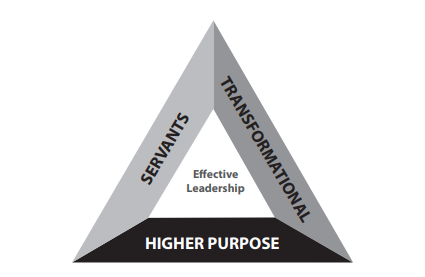
Effective Christian leadership is, therefore characterised by leaders who lead with a sense of a higher purpose, they seek to serve the people they lead, and their ultimate aim is to transform those they lead and their communities.
Genuine spiritual leadership has powerful results! Jesus began His ministry with twelve disciples. Once He finished training them to be servant leaders, He set them loose on the world. On their first day of ministry, over 3,000 people believed the message about Jesus (Acts 2:41). A few years later it was said of the disciples, “These who have turned the world upside down have come here too” (Acts 17:6 NKJV).
The results of Jesus’ leadership can be seen today in the hundreds of millions of people who call themselves Christians - followers of Christ.
REFLECTION AND APPLICATION
- Are there any differences between secular leadership and spiritual leadership?
- Write your personal definition of leadership.
- How will this definition help you become a better leader?
- Identify important insights you have gleaned about leadership from this chapter.
- What key words or concepts do you feel are crucial to being an effective spiritual leader?
EVALUATION AND ACTION
- How are you moving the people you lead to where God needs them to be?
- What practical ways can you adjust your leadership to focus on people more?
- How are you influencing people outside the Christian circles?
- How do you get to know what God’s agenda is?
- Spend time, individually and in small groups, praying about your leadership journey