
A man’s character is his.
Heraclitus
His master replied, “Well done, good and faithful servant! You have been faithful with a few things; I will put you in charge of many things. Come and share your master’s happiness!”
Matthew 25:21
Are leaders born or made? This question continues to dominate the area of leadership without conclusive answers. There are some natural characteristics found in some people that make them appear as leaders. There are others that can only be acquired through learning.
Whether in fact a person is born a leader or develops the necessary skills and abilities to become a leader is open for debate. There are some clear characteristics that are found in good leaders. These qualities can be developed or may be naturally part of their personality.
What are the character qualities that a leader or a pastor needs to lead a church?
The following Scriptures provide us with the necessary, credible characteristics for today’s pastors: 1 Timothy 3: 1-7, Titus 1:6-9, and 1 Peter 5:2
In 1 Timothy 3:1-7, Paul lists the following character requirements for a pastor-overseer:
He must be above reproach; the husband of one wife; temperate; self-controlled; respectable; hospitable; able to teach; not given to drunkenness; not violent but gentle; not quarrelsome; not a lover of money; one who manages his home well; not a new believer; and a person of good reputation in the community. Paul repeats most of these in Titus 1:6-9 and includes the following: This person loves what is good; is upright, holy, disciplined; and holds firmly to sound doctrine.
Some other necessary character qualities are found in 2 Timothy 2:2, such as competence (“qualified”), trustworthiness (“reliable”), and teachability.
In The Character of Leadership, Jeff Iorg identifies the following qualities of great leaders:
- Maintaining integrity
A person of integrity is a whole, complete, undivided person— not segmented or fractionalized. He has no double-dealing, no double standards, and no double meanings! Such a person is whole, complete, undivided in words, actions, and standards. Integrity occurs when a leader integrates their beliefs and actions with the standards of Scripture so there is consistency. You have integrity when you are the same in every place, in every circumstance, with every group of people. - Finding security
Secure leaders know who they are and what God created them to do. They understand their strengths and weaknesses, and are comfortable with both. Secure leaders feel less pressure to perform, less pressure to please people, and less pressure to prove their worth by their accomplishments. Secure leaders have an ease about them that engenders confidence among leaders to work with them because they are not afraid to share the work and the rewards. - Maintaining purity
Building moral purity and protecting it over a life-time is essential for your present effectiveness and positive leadership legacy. Leaving a positive leadership legacy takes a lifetime of effective ministry buttressed by solid Christian character. Moral failure calls into question everything about your ministry. Your followers lose trust in your moral authority and then wonder about everything you taught them. Moral failure leaves a legacy—a very negative one. - Learning humility
Humility is adopting God’s perspective on who you are and what you are assigned to do. It is the attitude that emerges from the spiritual discipline of thinking about yourself like God thinks of you. Humble leaders accept their God-assigned identity and mission. They have a balanced view of how God sees them. True, you are a sinner, but you are also a saint. You can do nothing good apart from God’s power, but you are also given spiritual gifts by God and expected to use them. You have a sinful bent that taints everything you do, but you are also enabled to do good works that really bless others. Humility is learning to live between these tensions. It is accepting the reality of who God says you are and living it daily. - Developing servant-hood
Servant leadership is, in its essence, an attitude. It is defined more by who the leader is than by what they do. A servant leader is driven by his or her love for God and people. Servant leadership happens when a proper ministry motive is expressed through your personal mission, shaped by your individual attributes, and applied in your assigned ministry setting. Servant leaders leave a vapor trail of the sweet aroma of Jesus’ humility formed in them. - Gaining wisdom
Wisdom is a required character quality for leaders in every field. Jesus is our model for life and leadership. He grew in wisdom; therefore, we can too. Leaders need to learn wisdom and grow in it. Your best sources for wisdom are God’s word and works. Learn from his word. Observe his works and learn from them. Another good source is wise people. Seek wise counselors—friends, parents, and mentors and learn from them. - Practicing discipline
Discipline is the ability to regulate your behavior by principle rather than impulse, reason rather than emotion, and long-range results rather than immediate gratification. Discipline is doing what is best, not what is easiest. You are disciplined when you choose to do difficult things and make them a habit. Leadership requires self-discipline. Leaders must be self-controlled. While the Holy Spirit enables you to develop discipline, you are still responsible to do it. - Showing courage
Positive leadership legacy will be undermined if fear controls you. Showing courage begins with confronting immobilizing fear. As you confront fear, your courage will grow. As it grows, you can expect God to allow even greater tests for you. The longer you lead, the more challenging the situations God will allow you to face. Doing what is right may cost you. But, in those critical moments, do not let the fear of what might happen keep you from doing the right thing. - Sustaining passion
Passion is a sustaining force that God ignites for ministry. Sustaining passion in ministry is rooted in the ability to see people as they really are.
PAUSE
- Are there additional qualities of great leader you can think of?
- Reflect on Joshua 1:7-9.
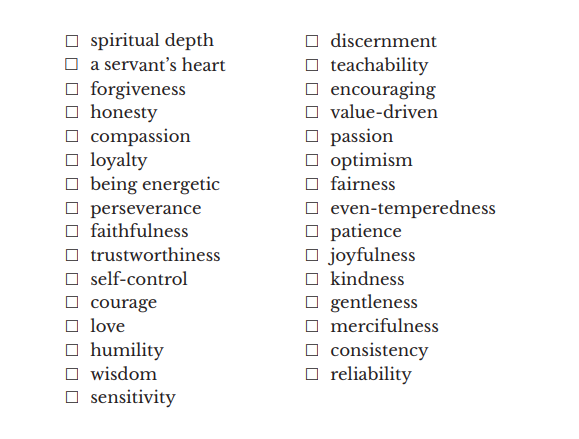
While these qualities do not represent a conclusive list, spiritual leaders need to exhibit Christ-like character. George Barna has identified several Christ-like character qualities of a leader which are:
REFLECTION AND APPLICATION
- What character qualities are evident in then leadership of your local church? How have they affected the church?
- Which character qualities are lacking in the leadership of the church today? Suggest what could be done for those qualities to be cultivated?
EVALUATION AND ACTION
- What are the character qualities that you need to function effectively as a leader in your ministry situation? Find Scriptures that support these qualities.
- What character qualities do you possess that attract people to follow you? What character qualities do you think hinder your effectiveness as a leader? your leadership?
- List the evidence that God’s Hand is on your leadership. If there is no manifest evidence, what ought you to do? Meditate on and discuss Mark 10:35-45.